
Every aircraft owner has been there. You're sitting at your dining room table the week before your annual inspection, surrounded by decades of logbook entries. Some pages are faded, others are filled with barely legible handwriting, and you're trying to answer one simple question: "When was the last time we complied with AD 2019-12-05?"
Hours later, you're still searching.
If this sounds familiar, you're not alone. Disorganized aircraft maintenance records are one of the most common—and most expensive—challenges in aircraft ownership. But the real cost isn't just the hours spent searching. It's what you miss, what you delay, and what you pay others to figure out for you.
The Time Tax: Hours That Add Up
Most aircraft owners don't realize how much time they spend managing logbook information until they actually track it. Consider the typical annual inspection preparation. You need to:
- Verify all recurring AD compliance dates
- Compile maintenance history for the past 12 months
- Identify any outstanding airworthiness directives
- Pull specific entries for your A&P mechanic to review
For an aircraft with 30+ years of history, this isn't a 30-minute task. It's easily hours of careful page-by-page review. And if you can't find something? You'll likely pay your A&P mechanic their hourly rate—now averaging $130 per hour—to do the research for you. That's not just inconvenient; it's an unnecessary expense that compounds at every annual inspection.

The Pre-Purchase Problem
For aircraft buyers, disorganized aircraft logbook history creates even bigger challenges. You've found the perfect aircraft. The pre-buy inspection is scheduled. But when you sit down to review the maintenance records, you discover:
- Logbook entries from three different mechanics with varying levels of detail
- Hand-written notes that are difficult to decipher
- Missing pages or unclear chronology
- No clear way to verify AD compliance without cross-referencing dozens of entries
A thorough pre-purchase logbook review should give you confidence in your investment. Instead, you're left with questions: Has this aircraft been properly maintained? Are there any damage incidents I should know about? Is there a pattern of deferred maintenance?
Without clear aircraft logbook organization, you're forced to either:
- Invest additional hours (or pay someone) to manually compile the history
- Accept incomplete information and hope for the best
- Walk away from a potentially good aircraft because the records are too unclear
None of these options are ideal when you're trying to make a purchase decision.
The Information You Never Find
Perhaps the most costly aspect of disorganized logbooks isn't what you spend time searching for—it's what you never discover at all.
Aircraft maintenance records contain critical information about your aircraft's history: minor damage repairs, recurring mechanical issues, parts that have been replaced, and compliance with service bulletins. This information matters for safety, resale value, and understanding your aircraft's true condition.
But if that information is buried in decades of handwritten entries, scattered across multiple logbooks, and written in varying levels of detail, you'll likely never see the full picture. You might miss:
- A pattern of recurring issues that suggests a deeper problem
- Previous damage history that affects resale value
- An AD that was complied with years ago but isn't clearly documented
This incomplete understanding of your aircraft logbook history doesn't just cost money—it costs peace of mind.
Why Traditional Aircraft Logbook Organization Fails
The problem isn't that owners don't care about their logbooks. It's that traditional paper-based systems weren't designed for searchability.
Aircraft can have service lives spanning 40, 50, or even 60 years. That's thousands of individual logbook entries, written by dozens of different mechanics, each with their own handwriting and documentation style. Even if you scan every page and save them as PDFs, you're still left scrolling through hundreds of pages trying to find one specific entry.
You can't search text. You can't filter by date range or type of maintenance. You can't ask your logbooks a simple question and get an immediate answer. Instead, you're stuck with manual review, every single time you need information.
The Solution: Intelligent Logbook Management
This is where modern aircraft logbook organization changes everything. Instead of spending hours searching through paper records, imagine being able to ask your logbooks anything in plain English:
- "When was the last 100-hour inspection?"
- "Show me all AD compliance entries from 2023"
- "Has there been any damage history?"
- "What maintenance was completed in the last 12 months?"
With intelligent logbook management, you get instant answers. The system reads your logbook entries—even handwritten ones—extracts the critical information, and makes everything searchable. Your aircraft's maintenance history becomes accessible in minutes instead of hours.
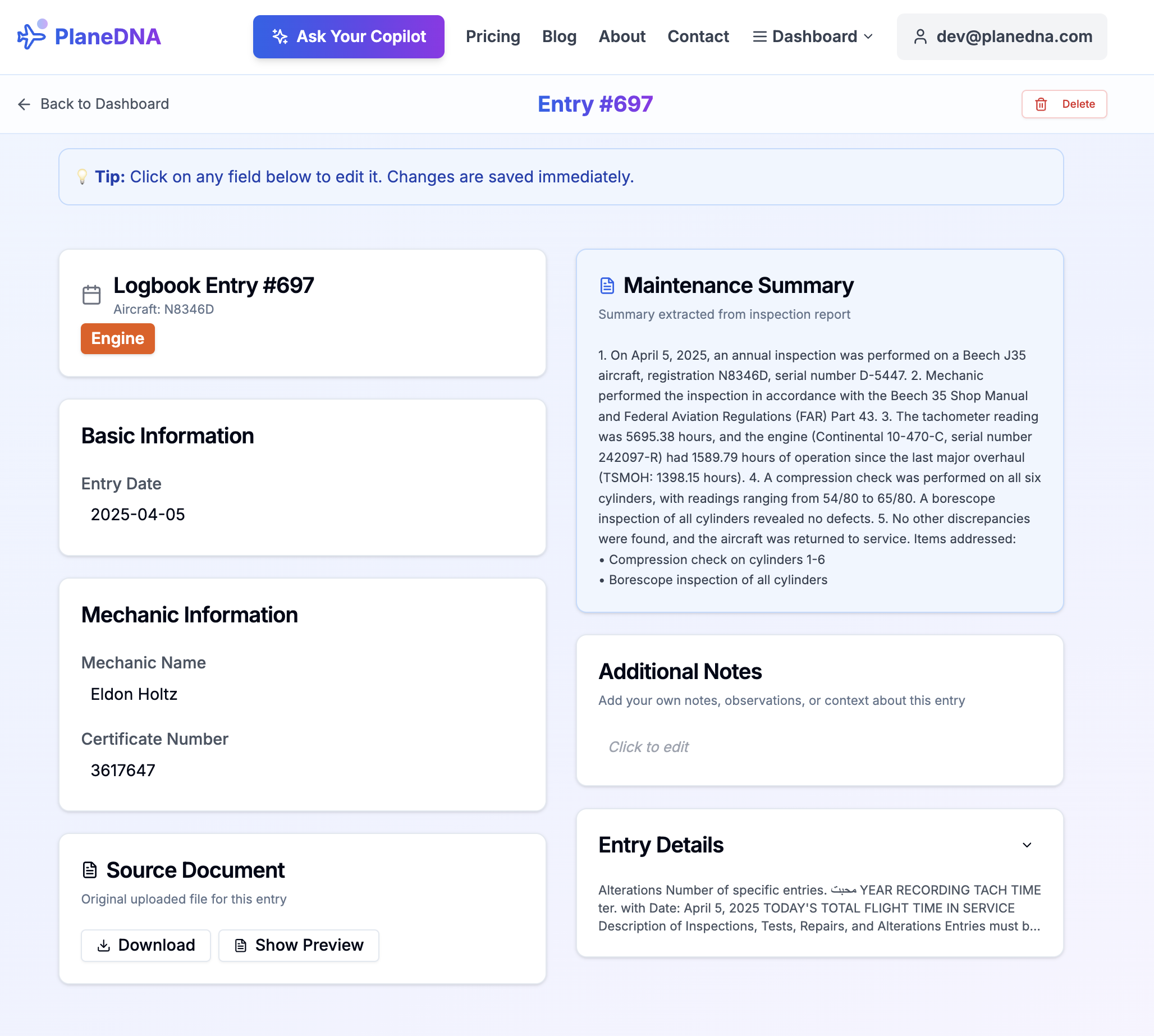
Annual Inspection Preparation Becomes Simple
When your annual inspection approaches, you're no longer scrambling to compile information. You can generate a complete report showing:
- All recurring AD compliance with next due dates
- Recent maintenance history
- Any outstanding items that need attention
Your A&P mechanic gets exactly what they need, in a clear format, without billing you for research time. Annual inspection preparation goes from a multi-hour ordeal to a 10-minute task.
Getting Started with Modern Logbook Management
The good news? You don't need to digitize your entire aircraft's 40-year history to see the benefits. Start with your most recent maintenance records—the entries that matter most for your upcoming annual inspection or that a potential buyer would want to see first.
PlaneDNA makes this easy. Upload 10 airframe logbook entries for free to experience how intelligent logbook management works. See how quickly you can search your records, generate compliance reports, and get answers to questions that used to take hours to research.
Once you experience the difference, you can upload your complete aircraft maintenance records—airframe, engine, and propeller logbooks—to create a fully searchable history of your aircraft. Learn more about our pricing and plans.
Stop Spending Hours, Start Getting Answers
Your logbooks contain decades of valuable information about your aircraft. That information should work for you, not against you. With modern aircraft logbook organization, you can stop spending hours searching and start spending minutes getting the answers you need.
Whether you're preparing for an annual inspection, considering an aircraft purchase, or simply want better visibility into your aircraft's history, intelligent logbook management gives you confidence, saves you time, and eliminates the hidden costs of disorganized records.
Visit planedna.com to transform your aircraft maintenance records from a filing burden into a searchable asset.
Ready to see how much time you can save on your next annual? Upload your first 10 logbook pages free at planedna.com.